Back in 2012, Robin Sloan released a “tap essay” called Fish—a meditation on what it means to like and love something on the internet. It’s a free app to download for Mac or iOS. I recommend you do so. It’s also something I revisit from time to time, simply because its message—that to love is to return—is, largely, timeless.
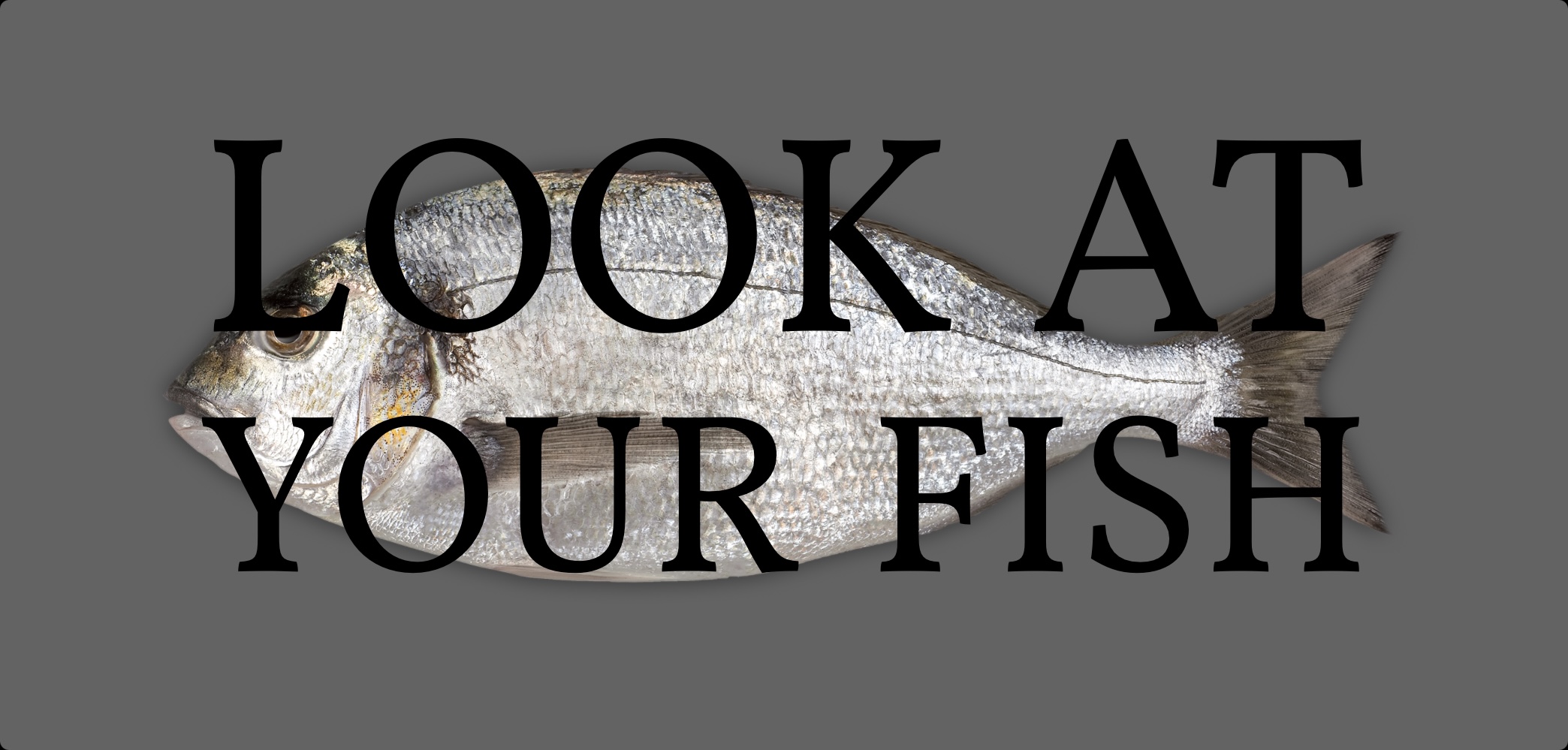
But in this era of AI content, I want to propose a corollary for Fish — choosing to manually create and consume has become a radical act of love. Taking the time to do intellectual labor the newly-hard way carries a meaning all its own. Much akin to a like on social platforms, generating with AI is increasingly cheap. I can go to Claude, or Gemini, or ChatGPT, (or, or, or) and feed it a bunch of information, and get at least a reasonable artifact in return.
And of course, recipients increasingly take what they receive and feed it into a large language model of their own!
“Ah yes, I have created a valuable, lengthy document,” the generator thinks. “Surely, my interlocutor will find this interesting. It contains so much information, and I could create it in such a short time!”
“I have received a lengthy document,” the recipient thinks. “It would be inefficient for me to read the entire thing, so I will have a machine summarize it for me and generate key takeaways.”
You could illustrate it thusly — {Human} -> {Machine} -> {Machine} -> {Human} 1
This model introduces an intellectual Prisoner’s Dilemma: If I spend time manually creating something, and my intended audience chooses to AI-truncate it, have I wasted my time? Or if I spend my valuable time reading something that was generated in moments without a second thought to its content, am I a sucker? Is the only way to move in this world to increasingly place a machine in front of myself, to accelerate my productivity by excising all but the last mile of intellectual labor?
I can feel my own writing and reading changing in response. Even when I am creating for other people at work, I will write for the LLM that I presume they will feed my words into. When someone sends me a document more than a page and a half long, I can feel the Green Goblin mask of AI summarization calling out to me, beckoning me to gloss, to treat my mental eye-roll towards redundancy or bulk as an excuse to give up focus.
After I trip over the tics of obviously AI-generated language in a document, I sense the bile in my throat as I feel bamboozled by the difference in effort. 2 3 And by the same token, I’ve felt the sheepishness that comes from hurriedly pawning off LLM-generated content that passed the “it looks reasonable” sniff test onto colleagues of mine when I can’t be bothered to so much as do the intellectual labor of editing the work in depth.
For Sloan, and for this recently passed era of the Internet, returning is an act of love. It is a reaction to the growing tide of great work—to say nothing of the ongoing inundation of content—that finding something worth turning over and over is a declaration of the highest order. And that holds true, if not even truer than before.
But in the face of what might be charitably called frictionless creation, that first act of intentional, effortful expense of time and brainpower is radical, too. (Even when involving an LLM at some point.) It is a declaration of caring, of saying that this matters to you in spite of the forces of automated summary and extrapolation. It’s the resistance to the Blinkist-ification of everything, of appending “Grok is this true” to every statement that comes your way, of asking a machine to spin the straw of a nascent idea into the gold of a blog post.
Compounding this is the act of staring that Prisoner’s Dilemma in the face and choosing to sideline a machine in that equation, regardless of your partner’s choice. There is a hope in that, hope for a world in which our care and love are accepted by those they are meant for. Knowing that we, as humans, will have to continue to live with each other, and create for each other.
And believing our lives can be enriched through our intention and effort, even when LLM-mediated ease awaits.
-
What does that machine translation layer add? What does it hide? Seeing this, I cannot help but think of Rosewatta Stone, a project that takes cards from Magic: The Gathering and repeatedly passes them through machine translation before churning out something hilariously uncanny — a reflection of a reflection of a reflection of a card that retains some reference to the original ideas, but is so transformed as to be quasi-unrecognizable. ↩︎
-
For so long, creation stood in for understanding. Large language models have broken this synecdochic contract, making it easy to present a simulacrum of knowledge and thought without the attendant mental processes. Perhaps this is a harbinger of a new era — in much the same way that it has long been possible to print documents without knowing how to operate a press, or use a computer without understanding a line of code — but this shift feels more fundamental to me, unmooring something that previously felt stable in how we interact with and understand each other as humans. ↩︎
-
Not lost on me in all of this is the difference that skill makes. For me, writing and thinking are inexorably linked — creating structured, readable prose is as transparent as organizing my thoughts, which I realize is not a universal experience. ↩︎